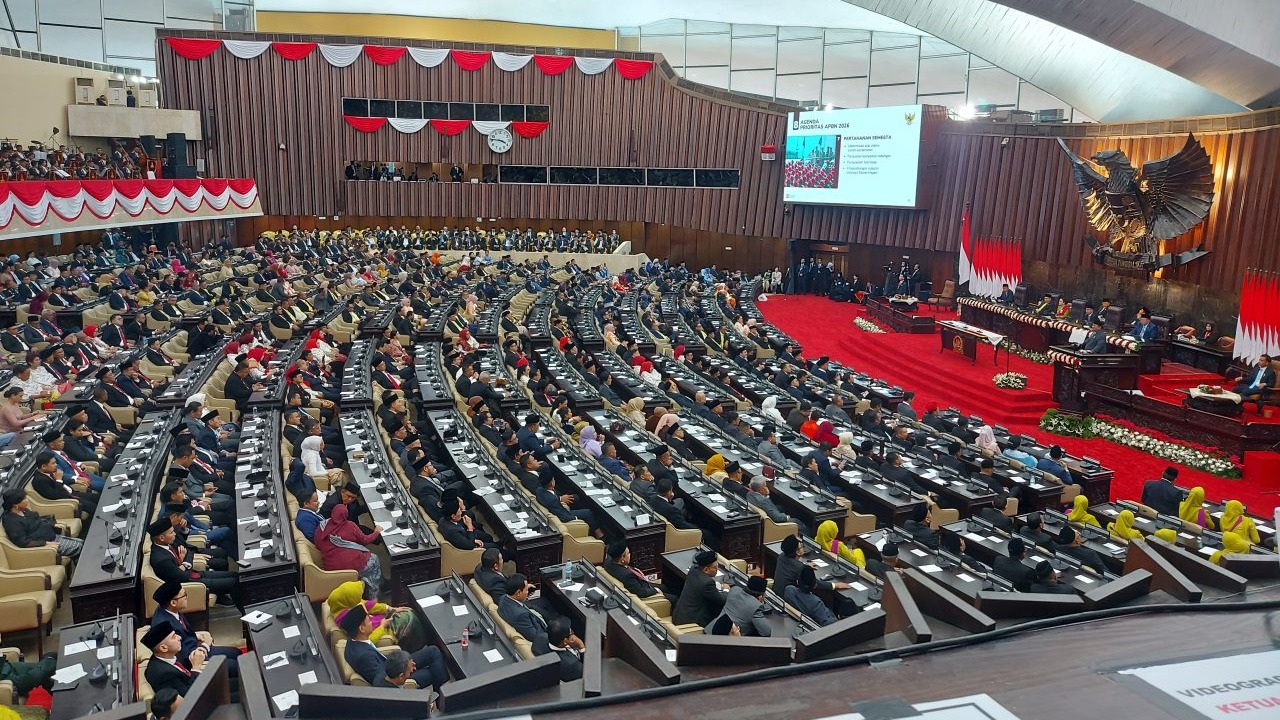
The People's Representative Council (DPR) of the Republic of Indonesia officially passed the Draft Lawon Agrarian Reform into law during the 6th Plenary Session of the First Session of the 2026–2027 Legislative Year at the Parliament Complex in Senayan, Jakarta, on Tuesday, September 22, 2026. The enactment was presided over by DPR Deputy Speaker Sufmi Dasco Ahmad and approved unanimously by all parliamentary factions.
10 Key Points
- The implementation of agrarian reform through state control, to ensure the fulfillment, restoration, and recognition of the people’s rights to land and other agrarian resources.
- Planning through a national roadmap outlines policy directions, phases, priorities, implementation strategies, and performance indicators.
- Identification of priority targets and beneficiaries of agrarian reform—including land resulting from both conflict resolution and non-conflict situations, with the primary beneficiaries being farmers, smallholders, farmworkers, fishermen, indigenous peoples, women, and the poor, based on location-specific criteria such as land ownership inequality, abandoned land, and absentee-owned land.
- The establishment of an agency to implement agrarian reform that reports directly to and is accountable to the President, with authority over planning, implementation, oversight, and conflict resolution—supplemented by a Supervisory Board to ensure transparency and accountability.
- A mechanism for resolving agrarian conflicts that prioritizes deliberation, the restoration of social relations, legal certainty, and the restoration of community rights.
- Restoration of land rights and land redistribution, including the provision of legal certainty and empowerment for those affected by agrarian reform.
- Legal protection and the prevention of new conflicts, including for community advocates, whistleblowers, and witnesses, by applying the principle of free, prior, and informed consent.
- The regulation, control, and limitation of land tenure and ownership, to prevent land concentration and ensure equitable distribution—including maximum ownership limits, for which the government is currently drafting implementing regulations.
- Funding for the implementation of agrarian reform comes from the State Budget (APBN), the Regional Budget (APBD), and other legitimate and non-binding sources, and is supported by an integrated data system to ensure accountability.
- Criminal provisions, transitional provisions, and reporting requirements, to ensure compliance and the continuity of implementation, with mandatory performance reports to be submitted to the President and the House of Representatives at least once a year.
This article is for informational purposes only and has been prepared for general educational purposes. The content of this article is not intended to serve as legal, tax, or financial advice for any specific case. For further consultation regarding your business needs, please contact our team of professionals through this channel