Despite the adjustment challenges faced by some taxpayers, it is important to understand that Government Regulation No. 20 of 2026 is fundamentally grounded in stronger tax fairness. The Final Income Tax Facility for MSMEs was designed from the outset as an affirmative measure to ease the administrative burden on MSME operators who are genuinely in need, not as a tax loophole for high-income individuals or large business groups that deliberately fragment their business structures.
Facilities Born of Good Intentions, Yet Prone to Abuse
The final income tax (PPh) regime on gross revenue was first implemented through Government Regulation No. 46 of 2013, with an initial rate of 1%. Subsequently, this rate was reduced to 0.5%, along with adjustments to the relevant regulations, through Government Regulation No. 23 of 2018 and Government Regulation No. 55 of 2022. This policy has become one of the most popular tax incentives among Micro, Small, and Medium Enterprises (MSMEs) in Indonesia. The reason is simple: taxpayers simply multiply the 0.5% rate by their monthly gross revenue, without having to go through the hassle of preparing detailed financial records as required under the general income tax scheme, which is based on net profit.
However, the convenience that serves as the main selling point of this scheme also, in practice, opens up a wide loophole for abuse. Over the years, various practices have emerged in which medium- to large-scale businesses and high-income professionals have taken advantage of the leniency of these regulations in various ways—even though this deviates from the original purpose of the policy, which was to ease the administrative burden on MSME operators who truly need it.
In response to this issue, the government issued Government Regulation No. 20 of 2026 (PP 20/2026) as an amendment to PP 55/2022, which took effect on April 22, 2026.PolicyThis brings about significant changes regarding who is eligible to benefit from the final income tax facility for MSMEs. This article discusses what has changed, why these changes are necessary, and what the implications are for MSMEs, business entities, and professionals.
Understanding the Final Income Tax Scheme for MSMEs and the Issues Behind the Revision
Before delving into the changes introduced by Government Regulation No. 20 of 2026, it’s worth first understanding how this scheme works and the reasons behind its popularity. The Final Income Tax Scheme for MSMEs imposes a flat rate of 0.5% directly on gross revenue (turnover), rather than on net profit as is the case with the general income tax scheme. This benefit is available to taxpayers whose gross revenue does not exceed Rp4.8 billion per year.
The main advantage of this scheme lies in its administrative simplicity: taxpayers do not need to maintain accounting records; they simply record their gross revenue and then calculate the tax due directly from that figure. For truly micro- and small-scale MSME operators—such as small-stall vendors, home-based online sellers, or small service providers—this convenience significantly lightens the administrative and tax compliance burden, which would certainly feel disproportionate if they were subject to the much more complex general income tax scheme.
However, on the other hand, because taxes are calculated directly from revenue without taking into account the actual cost structure and profitability, this scheme is actually very advantageous for taxpayers with high profit margins. As a simple illustration, a professional with specialized expertise—say, a consultant or a professional service provider—who has a net profit margin exceeding 50% of their revenue, would be far better off using the 0.5% Final Income Tax scheme based on revenue rather than the general income tax scheme, which has a progressive rate of up to 35% of net income for high-income individuals.
It is precisely these conditions that have led to the emergence of various “schemes” in structuring businesses. One of the most common examples is the establishment of business entities—particularly in the form of sole proprietorship limited liability companies (PT), which could previously be easily established following the enactment of the—by professionals solely to reclassify their income from self-employment income (subject to progressive tax rates) to business income (which qualifies for a flat 0.5 percent tax rate). This practice is known in tax terminology astax arbitrage—exploiting a loophole in the tax treatment between two business structures that are, in economic substance, identical, solely for the purpose of obtaining a tax advantage.
BunchingandFirm Split: The Root Cause Behind the Revision
Two patterns of misuse highlighted by the DGT and the World Bank are bunchingandcompany spin-off.Bunchingrefers to the practice of keeping reported revenue below the Rp4.8 billion threshold. In the 2024 Tax Expenditure Report, the DGT revealed a surge in the number of corporate taxpayers with revenue just below the Rp4.8 billion mark, while those above it were scarce—a statistical pattern that strongly indicates the existence of this type of behavior. Meanwhile, the World Bank, in a reportEstimating VAT and Corporate Income Tax Gaps in Indonesiahighlighting that threshold as a trigger forpolicy gap(since taxpayers below the threshold enjoy income tax benefits and are exempt from VAT obligations) as well ascompliance gap(because they are not required to maintain accounting records and are rarely subject to oversight).
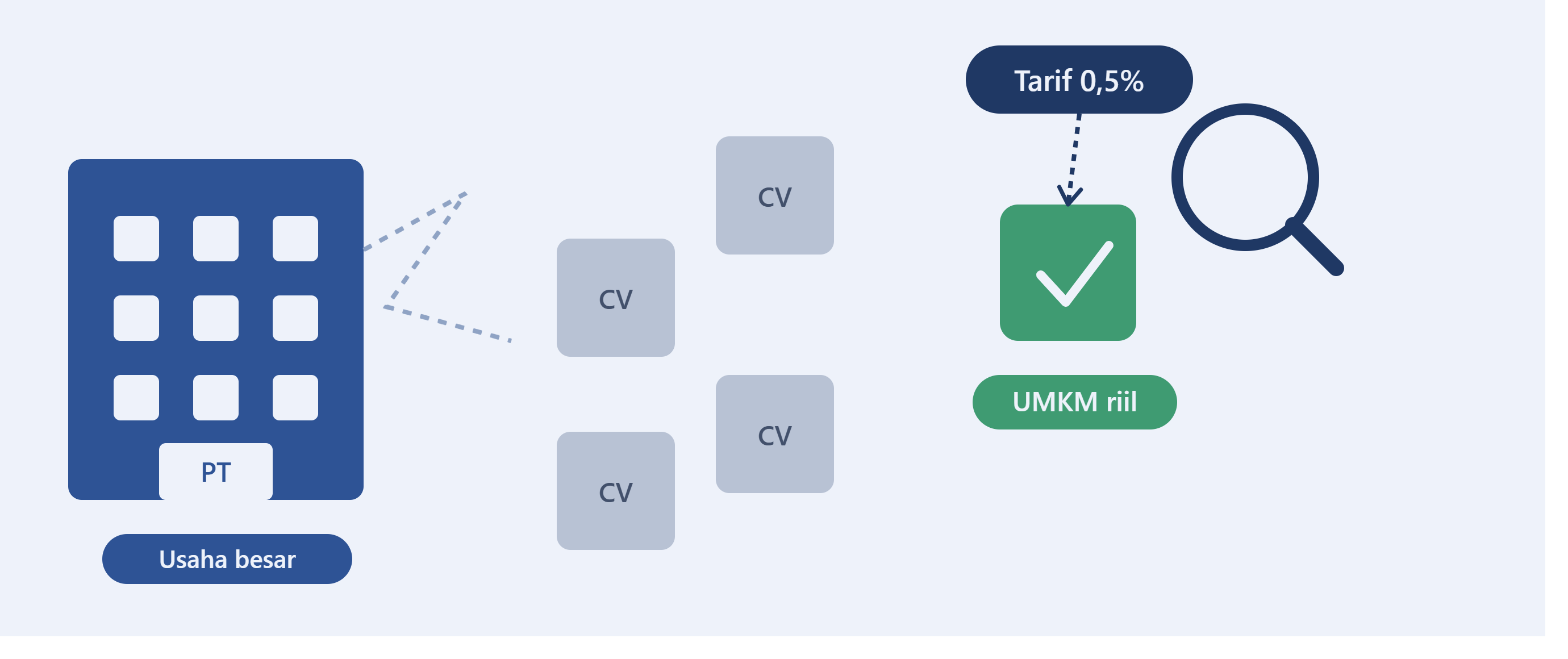
Firm splitrefers to the practice of splitting a single large business into many small business entities—for example, by establishing numerous limited partnerships (CVs), whether in one’s own name, that of relatives, employees, or nominees—so that each entity’s revenue appears to be below the threshold, even though, in substance, they constitute a single, unified business. The Directorate General of Taxes (DJP) describes this practice as a “giant in a toddler’s outfit”: an established business that splits itself into smaller entities to continue enjoying benefits intended for businesses that are truly just starting out—a phenomenon also known asPeter Pan syndrome.
Both of these practices cause harm in three ways at once: they erode government revenue, exacerbate disparities in treatment (employees are subject to the full income tax under Article 21 without exception, while large businesses keep their effective tax rates far below what they should be), and restrict the growth opportunities that are actually intended for genuine MSMEs. These findings form the basis for the amendments to Articles 57 and 58 of Government Regulation No. 20 of 2026: a revenue consolidation mechanism has been introduced to addresscompany split, while narrowing the scope of who is eligible to use this program closes off one of the most popular avenues for this practicebunching, namely through the establishment of a limited liability company (CV). However, the World Bank believes that this step has not fully resolved the issue, given that the Rp4.8 billion threshold itself has not changed—so it is not unlikely that this issue will remain a focus of oversight and a topic for policy refinement in the future.
What Has Changed in Government Regulation No. 20 of 2026?
Restrictions on Groups of Taxpayers Eligible for Tax Benefits
The most fundamental change lies in the narrowing of the group of taxpayers eligible to use the 0.5% final income tax facility. Now, this benefit is available only to three groups of taxpayers: individuals, sole proprietorships established by a single person, and cooperatives—provided their gross revenue does not exceed Rp4.8 billion per year.
The implications of this change are significant: Business entities in the form of a Commanditaire Vennootschap (CV), a general partnership (Firma), a conventional Limited Liability Company (PT) (not a sole proprietorship), and Village-Owned Enterprises (BUMDes) can no longer become new participants in the Final Income Tax (PPh Final) scheme for Micro, Small, and Medium Enterprises (MSMEs). Previously, under the regime of Government Regulation No. 55 of 2022, business entities of any form—including conventional PTs with complex shareholding structures—could essentially take advantage of this facility as long as they met the revenue threshold.
Interestingly, cooperatives can still enjoy this benefit—a form of policy support for cooperative growth during their early operational phase. However, this benefit for cooperatives is not valid indefinitely; it is limited to four tax years from the date the cooperative is registered as a taxpayer. After this period, cooperatives are required to transition to the general taxation system. This time limit can be understood as the government’s effort to encourage cooperatives to gradually improve their administrative and accounting capabilities so that they are prepared to fully comply with their tax obligations once the incentive period ends.
Expanding the Definition of Self-Employment
In addition to conventional professions (lawyers, accountants, doctors, notaries, consultants), professions that have emerged and evolved alongside the digital economic transformation have now been explicitly added:influencer,Instagram influencer,blogger, andvlogger. This expansion reflects the government’s recognition that the digital economy has given rise to a new group of professionals with incomes that are often quite substantial—content creatorAnd digital public figures with millions of followers, for example, can generate income that far exceeds that of many conventional professionals—yet they have long had the potential to take advantage of the final income tax scheme for MSMEs by establishing a business entity to reduce their effective tax burden.
With this change, individuals who engage in activities asinfluencer, vlogger, or similar professions classified as self-employment, can no longer use their business entity status (including sole proprietorships) to take advantage of the 0.5% final tax rate. Their income, regardless of the business entity structure used to channel it, will be subject to the general income tax (PPh) scheme with progressive rates, as is customary for income from other self-employment activities.
Reaffirmation of the Prohibition on Sole Proprietorships Engaged in Professional Services
To supplement the expanded definition of self-employment outlined above, Government Regulation No. 20 of 2026 also specifically states that a Sole Proprietorship established by an individual taxpayer with specialized expertise who provides services similar to those of self-employment are not eligible to utilize the final income tax facility for MSMEs, even though, from a legal standpoint, they are classified as Sole Proprietorships—which would otherwise fall under the permitted category.
This provision is specifically designed to close the tax arbitrage loophole described earlier—where, until now, a significant number of professionals (doctors, lawyers, consultants, and the like) have established sole proprietorship limited liability companies (PT) solely so that income from their professional practices would be subject to a flat final tax rate of 0.5%, rather than the progressive individual income tax rates applicable to income from self-employment. With this new regulation, the government explicitly ensures that the use of a business entity—even in the form of a sole proprietorship, which is actually permitted to enjoy this benefit—cannot be used solely as a tax-saving instrument if the economic substance remains the freelance services of an individual professional.
Consolidation of Revenue
Government Regulation No. 20 of 2026 introduces provisions on revenue aggregation that are far more comprehensive than previous regulations, requiring the aggregation of gross revenue from all entities and certain family members with ownership ties, in determining whether the Rp4.8 billion threshold has been exceeded.
Under this mechanism, a business group that is effectively controlled by the same individual or family—but has been split into several separate business entities or sole proprietorships to keep each entity below the revenue threshold—will now be assessed on an aggregate basis. If the combined total revenue of all related entities exceeds Rp4.8 billion, then all entities in that group will lose the right to use the Final Income Tax for MSMEs facility and will be required to switch to the general income tax scheme.
This anti-fragmentation approach indicates that the government now assesses the actual economic substance of a business group, rather than merely the formal legal structure of each separate entity—an approach consistent with the “substance over form” principle, which is also widely applied in various international tax avoidance provisions.
Revision of the Time Limit Provisions
The previous provisions regarding the term of the facility have been removed and incorporated into new, more comprehensive sections.
Bribes and Gratuities Are Not Deductible Expenses
Beyond the context of MSMEs, this Government Regulation also stipulates that expenditures in the form of bribes, gratuities, or gifts related to corruption cannot be deducted from gross income. Although this provision is not directly related to the MSME Final Income Tax scheme, its inclusion in the same regulatory package underscores the government’s policy direction, which generally seeks to strengthen the integrity of the national tax system while aligning tax policies with anti-corruption efforts.
Transitional Provisions
One of the aspects most eagerly awaited by the business community when a new regulation is issued is how the transitional provisions will address the situation of taxpayers who have already taken advantage of benefits under the old provisions. Government Regulation No. 20 of 2026 provides fairly clear certainty in this regard. For taxpayers—including business entities in the form of limited partnerships (CV) and conventional limited liability companies (PT)—that have already taken advantage of the 0.5% final income tax (PPh Final) facility under the provisions of Government Regulation No. 55 of 2022 before Government Regulation No. 20 of 2026 took effect, the government has provided a transition period that allows them to continue using this facility until the utilization period under the old regulations expires—rather than having it terminated immediately upon the new regulation taking effect. As a concrete example, individual taxpayers who have taken advantage of the 0.5% final income tax scheme in the 2024 tax year may still use that rate in the 2025 and 2026 tax years, in accordance with the applicable utilization period for their group under previous regulations.
Interestingly, specifically for individual taxpayers, Government Regulation No. 20 of 2026 actually provides greater certainty: the 0.5% final income tax rate for this group can essentially be enjoyed indefinitely (applicable forever), as long as other requirements—particularly the revenue threshold of Rp4.8 billion and the exclusion of income from self-employment (the scope of which has been expanded)—continue to be met. This provision reaffirms that the intent of the reforms in Government Regulation No. 20 of 2026 is not to create difficulties for genuine micro- and small-scale MSMEs directly operated by individuals, but rather to close loopholes that have long been exploited through improper business entity structures.
Practical Implications for Various Taxpayer Groups
The changes introduced by Government Regulation No. 20 of 2026 have varying implications depending on the characteristics and business structure of each taxpayer. Let’s examine the implications by group.
For individual taxpayers engaged in actual business operations (merchants, non-professional service providers, and operators of conventional MSMEs), this change essentially brings good news: the certainty that the 0.5% final income tax benefit can continue to be enjoyed indefinitely, as long as the revenue threshold and other criteria remain met. This group has, in fact, been the primary target of this incentive policy from the outset, and Government Regulation No. 20 of 2026 further strengthens legal certainty for them.
For business entities in the form of CVs, partnerships, and conventional PTs that are about to be established, the implications are quite significant: they can no longer take advantage of the final income tax facility for MSMEs from the outset of their establishment, and must prepare to maintain accounting records and calculate tax liabilities based on the general income tax scheme starting from their first year of operation. This requires more thorough preparation in terms of financial management and administration, as the general income tax scheme demands more comprehensive bookkeeping than simply recording gross revenue.
For existing business entities—such as CVs, general partnerships, and conventional PTs—that have already taken advantage of previous provisions, the transitional provisions provide some breathing room until the benefit period under the old regulations expires. However, this also means they need to begin preparing gradually—including by establishing an adequate accounting system—to navigate the transition to the general income tax scheme, which will eventually apply to them.
For sole proprietorships established by professionals (doctors, lawyers, consultants, accountants, and similar professions) who engage in activities that are, in substance, self-employment, the provisions of Article 57(2)(b) close a loophole that they have been exploiting. This group needs to immediately evaluate its business structure and prepare to transition to the general income tax scheme for self-employment income, with the progressive tax rates applicable to individuals.
For content creators, influencers, and similar digital professionals, the expansion of the definition of self-employment carries similar consequences: their income, regardless of the legal entity they use, is now explicitly categorized as self-employment income and can no longer benefit from the 0.5% final tax rate. This group, which has grown rapidly over the past few years alongside the development of the digital creator economy in Indonesia, needs to immediately adjust their tax planning to this new reality.
For family-owned business groups or business groups comprising several separate entities, the revenue consolidation requirements necessitate a comprehensive evaluation of the ownership structure and interrelationships among the entities within the business group. The practice of maintaining several separate business entities, each with revenue kept below the threshold, now carries a high risk of being identified as business fragmentation, which would result in all entities within the group being required to switch to the general income tax scheme simultaneously.
For cooperatives, the introduction of this new tax incentive is a form of support that should be utilized to the fullest during the initial establishment phase; however, it also requires long-term planning, given the four-year time limit, so that cooperatives are not “caught off guard” when they must transition to the general income tax scheme after the incentive period ends.
Preparatory Steps That Need to Be Taken
In light of these significant changes, there are several concrete steps that the various affected taxpayer groups need to consider immediately.
First, conduct a comprehensive evaluation of your current business structure. For professionals who established a business entity (including a sole proprietorship) solely for tax efficiency purposes, now is the time to reassess whether that structure remains relevant and advantageous under the new regime, or whether it needs to be restructured.
Second, for businesses that will lose access to the Final Income Tax (PPh) facility for MSMEs—whether due to their legal structure (CV, partnership, conventional PT) or because they are classified as self-employed—it is time to begin preparing an adequate bookkeeping infrastructure. The general income tax scheme requires far more comprehensive record-keeping, including the separation of deductible and non-deductible expenses, asset depreciation, and fiscal reconciliation between commercial financial statements and tax financial statements.
Third, for family-owned businesses or business groups comprising multiple entities, conduct a comprehensive mapping of the ownership structure and interrelationships among the entities to objectively assess whether the structure could potentially be categorized ascompany splitbased on the new revenue consolidation rules. If so, consider consolidation or restructuring measures that are more transparent and consistent with the actual economic substance of the business group.
Fourth, make the most of the available transition period. For taxpayers who can still take advantage of benefits under the old regulations until a certain deadline, use this period to gradually prepare—in terms of accounting systems, human resources, and cash flow planning—for the transition to the general income tax scheme, which will eventually take effect.
Fifth, consult a professional tax advisor regarding the specific circumstances of your business. Given the complexity of these new regulations—particularly regarding the expanded definition of freelance work and the revenue aggregation mechanism—an accurate assessment of a business’s tax status and obligations requires an in-depth analysis of the specific facts and circumstances of each taxpayer, which cannot be simply generalized.
Weighing the Fairness Behind Policy Tightening
Despite the adjustment challenges faced by some taxpayers, it is important to understand that the policy direction of Government Regulation No. 20 of 2026 is fundamentally rooted in the principle of greater tax fairness. The Final Income Tax Facility for MSMEs was designed from the outset as an affirmative measure to ease the administrative burden on micro and small business owners who are truly in need—not as a tax loophole for high-income individuals or large business groups that deliberately fragment their structures.
By narrowing the group of individuals eligible for these benefits, expanding the definition of self-employment, and closing loopholes related to business fragmentation, the government is essentially striving to realign this policy with its original objectives—while ensuring that the government’s revenue base from taxpayers who are truly capable of making larger contributions is not eroded by aggressive tax planning practices. At the same time, the assurance that individual taxpayers operating actual businesses can continue to benefit from this facility indefinitely demonstrates that the policy’s affirmative spirit toward genuine MSMEs remains intact—and is even being strengthened.
A Moment to Restructure the Business in a More Transparent Way
The revision of the final income tax for MSMEs through Government Regulation No. 20 of 2026 marks a significant turning point for all business operators—including actual MSMEs, medium-sized businesses, and individual professionals—to restructure their business operations and tax planning in a more transparent manner that aligns with the true economic substance. Simple and lenient tax incentives are now truly directed toward the groups that have been the intended targets of the policy from the outset, while loopholes that have long been exploited for improper tax savings are gradually being closed.
For businesses affected by these stricter measures, these changes should be viewed not as a punishment, but as an incentive to build a more robust foundation for financial and tax governance—an investment that will ultimately strengthen the business’s resilience and credibility in the long term, while also contributing to a national tax system that is fairer and more integrity-driven for all parties.
This article is intended for general educational purposes and is not intended as tax advice for specific cases. For a specific analysis of the impact on your business structure under Government Regulation No. 20 of 2026, please consult with our team of tax consultants.