The sharp increase in SP2DK notices in 2026 is driven by Coretax, the use of the NIK as the NPWP, and expanded access to financial data. This notice is merely an initial clarification step—not a tax audit—and by responding in a timely and evidence-based manner, taxpayers can halt the process at this stage. The key lies in proactive compliance: orderly bookkeeping, separate business accounts, and transaction documentation ready for verification at any time.
Introduction: The Brown Envelope That Changed the Way Taxpayers Think
There is one experience that has gradually become a collective reality for the Indonesian business community in recent years: receiving an official letter on the letterhead of the Directorate General of Taxes (DJP) requesting an explanation regarding specific data. This letter is widely known as the SP2DK—Letter Requesting an Explanation of Data and/or Information. For some business owners, receiving this letter still triggers a spontaneous reaction of panic, as if it were the beginning of a frightening legal process. In reality, however, when properly understood, the SP2DK is actually an initial communication tool—not a verdict, nor is it a tax audit in the formal sense.
What makes this issue relevant for in-depth discussion in 2026 is its scale and intensity. Various tax practitioners predict that this year will be marked by a wave of SP2DK notices that is far more massive than in previous years, driven by a number of intertwined structural factors: the strengthening of the database through the implementation of the National Identity Number (NIK) as the Taxpayer Identification Number (NPWP), the expansion of access to financial information for tax purposes, the full migration to the Coretax system, and a new legal framework governing more systematic compliance oversight through PMK 111/2025. This article will thoroughly examine this phenomenon—from its legal basis and operational mechanisms to the reasons behind the surge, as well as the concrete steps that MSMEs and corporations need to take to navigate it effectively.
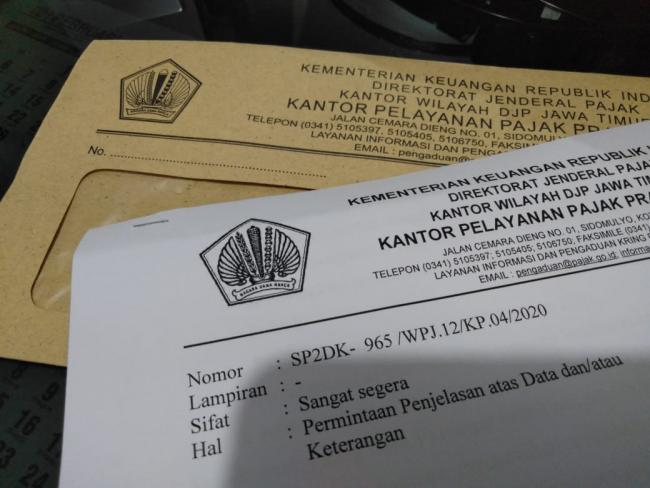
SP2DK Sample | Source: www.pajak.go.id/
What Exactly Is an SP2DK?
By definition, an SP2DK is a letter issued by the Head of the Tax Service Office (KPP) to request clarification from a taxpayer regarding specific data and/or information held by the tax authority. It is important to emphasize from the outset: an SP2DK is not a tax audit. It is a pre-audit stage—a sort of “double-check” mechanism that gives taxpayers an opportunity to explain themselves before the tax authorities take more formal and intrusive steps.
An SP2DK is typically issued due to several triggers. The most common trigger is a discrepancy (mismatch) between the data reported by the taxpayer in the Tax Return (SPT) and the data held by the DGT from other sources—such as third-party tax withholding/collection data, bank transaction data, customs data, electronic transaction data, and data from other government agencies. Additionally, an SP2DK may also be issued based on the results of an automated compliance risk analysis conducted by the DGT system, in which certain taxpayer profiles—such as an profit margin that is disproportionately high compared to similar industries, turnover growth inconsistent with assets held, or unusual transaction patterns—are flagged as high-risk for further examination.
It is important to understand that the SP2DK differs from two other instruments that are often confused in the public’s perception: the Audit Findings Notice (SPHP) and the Tax Assessment Notice (SKP). The SPHP is issued at the final stage of the formal tax audit process, informing the taxpayer of the auditor’s findings prior to the issuance of the tax assessment. The SKP, on the other hand, is the final legal outcome of the audit process, which determines the amount of tax due, overpayment, or no tax owed. The SP2DK comes well before these two instruments—it is the taxpayer’s first and least burdensome opportunity to explain their position before the process proceeds to more formal and higher-risk stages.
Legal Basis Underpinning the SP2DK Mechanism
To date, the procedures for implementing the SP2DK have largely been based on the Director General of Taxes’ Circular Letter No. SE-05/PJ/2022, which governs the stages ranging from data research and analysis, the issuance of letters, response deadlines, and follow-up in the form of a Report on the Results of Requests for Clarification of Data and/or Information (LHP2DK). As of 2026, this oversight framework was significantly strengthened through Minister of Finance Regulation No. 111 of 2025 (PMK 111/2025), which was promulgated on December 30, 2025, and took effect on January 1, 2026.
PMK 111/2025 specifically sets forth more comprehensive provisions for monitoring taxpayer compliance, covering the monitoring of registered taxpayers, unregistered taxpayers, and region-based monitoring. Some key provisions in this regulation include providing clearer legal certainty regarding taxpayers’ rights and obligations in responding to SP2DK notices. Article 6(1) of PMK 111/2025, for example, states that taxpayers have two options for responding: first, to pay any underpaid taxes if a deficiency exists; second, to submit an explanation accompanied by supporting evidence if the taxpayer believes their report is correct.
In terms of timeframes, PMK 111/2025 also provides more breathing room compared to previous practices. Pursuant to Article 6(2), taxpayers are given 14 calendar days from the date the SP2DK is received or issued to submit a response. What sets this new regulation apart is that taxpayers are now given the option to request an extension of the response period for up to seven additional calendar days, provided that the extension request is submitted and received by the Tax Office before the 14-day period expires. Thus, the maximum total time available for taxpayers to respond to the SP2DK can reach 21 calendar days. This provision also clarifies that taxpayers may submit explanations more than once as long as they do so within the specified timeframe—allowing taxpayers the flexibility to supplement their explanations in stages if necessary.
Regarding the method of submission, the calculation of the time period begins from the earlier of the following events: the date of issuance of the SP2DK if submitted via Coretax, or the date of transmission of the SP2DK via the email address registered in the DGT system. This underscores the move toward full digitization of the tax oversight process, in line with the implementation of Coretax as the sole channel for tax administration starting in 2026.
How the SP2DK Works: From Data Matching to Results Reports
To understand why the number of SP2DK notices is expected to rise sharply, it is important to understand how the mechanism works from a technical standpoint. This process essentially begins long before the notice is sent to the taxpayer—namely, during the data analysis (data matching) phase, which is conducted systematically by the DGT.
At this stage, the DGT’s information system compares the data reported by taxpayers in their tax returns with various external data sources: income tax (PPh) and value-added tax (PPN) withholding/collection data from transaction counterparties, financial transaction data from banks and financial service institutions, electronic transaction and marketplace data, customs data from the Directorate General of Customs and Excise, as well as data from agencies, institutions, associations, and other parties (ILAP) that are legally required to submit data for tax purposes. When the system detects a discrepancy—for example, if the revenue reported on the tax return is significantly lower than bank account transactions, or if the value of import-export transactions does not match VAT reporting—the case is flagged for further analysis by tax officials at the Tax Office (KPP).
If the analysis results indicate a sufficiently strong risk of noncompliance, the Head of the Tax Office will issue an SP2DK. In accordance with applicable technical regulations, this letter must be delivered to the taxpayer no later than three days from the date of issuance, through various channels such as fax, postal service, in-person delivery, or via the taxpayer’s Coretax/DJP Online account.
Once the SP2DK is received, the ball is in the taxpayer’s court. Within the timeframe described above, the taxpayer may submit a written response, in person at the Tax Office, or even via audio-visual media—a relevant flexibility given that some taxpayers are located far from the Tax Office where they are registered. The response submitted is then reviewed by tax officials and compared with the results of the initial data analysis. If necessary, further discussions may be held, either in person or through a visit to the taxpayer’s business location, with the entire process documented in an official record.
The culmination of this entire process is the preparation of the Report on the Results of the Request for Clarification of Data and/or Information (LHP2DK), which contains conclusions and recommendations for follow-up actions. There are three possible outcomes: first, if the taxpayer’s explanation is deemed sufficient and supported by strong evidence, the process is considered complete with no further consequences—the Tax Office will issue a follow-up notification stating that the case is closed. Second, if the clarification process reveals that there is indeed an underpayment of taxes, the taxpayer will be directed to amend their tax return and pay the outstanding amount, usually accompanied by an administrative penalty in the form of interest—though this penalty is relatively much lighter than the penalties imposed during the formal audit stage. Third, and this is the riskiest scenario: if the taxpayer is uncooperative, fails to provide any response at all, or the explanation provided is deemed insufficient, the case may be referred to the formal tax audit stage—and under certain circumstances, even to a preliminary evidence review that could potentially lead to criminal tax proceedings.
Impact and Implications for MSME Operators
For many MSME operators, the issue of SP2DK may seem distant and relevant only to large companies. This perception is mistaken and potentially dangerous. In fact, the expansion of the taxpayer base through the NIK-NPWP system and the strengthening of ILAP data mean that MSMEs—including sole proprietors, home-based businesses, and online sellers—are among the groups most affected by this expanded scope of oversight.
Some common patterns of data discrepancies found in the MSME sector include: revenue reported on tax returns that does not match the transaction records of business accounts or personal accounts used for business activities; payments received through e-commerce platforms or digital wallets that are not recorded in the books; and the use of personal accounts for business transactions, which blurs the distinction between personal and business income. As this data becomes more accessible to the DGT through third-party reporting requirements, potential discrepancies that were previously “hidden” become much easier for the system to detect.
For MSME owners, the most fundamental and urgent step is to start establishing sound administrative practices early on, long before the SP2DK notice actually arrives. This involves several concrete steps: strictly separating business financial accounts from personal accounts; consistently recording every business income and expense transaction—even using simple bookkeeping methods; ensuring that the revenue reported in the Annual Tax Return (SPT Tahunan) and the Final Income Tax Return (SPT Masa PPh Final) for MSMEs is consistent with the actual receipts recorded in bank accounts and digital platforms, and keeping transaction records (invoices, receipts, transfer confirmations) neatly organized and easily accessible should they be requested at any time.
It is also important for MSME owners to understand that receiving an SP2DK is not the end of the road, and does not always result in severe penalties. As emphasized in PMK 111/2025, taxpayers whose reports are already accurate need only provide a clarification accompanied by sufficient supporting evidence. Excessive fear can actually lead to an inappropriate response—such as ignoring the letter out of panic, which in turn increases the risk of escalation to a formal audit, a far more burdensome process.
Impact and Implications for Corporations
For corporations, particularly medium- to large-sized ones, the challenges they face are different in nature but no less significant. The complexity of corporate business structures—which involve various types of transactions such as related-party transactions, transfer pricing, cross-jurisdictional transactions, and complex financing schemes—makes the potential for data discrepancies that could trigger an SP2DK far more diverse.
Some areas that are generally the focus of the DGT’s oversight of corporations include: the reasonableness of gross profit and net profit ratios compared to the industry average; consistency between the transaction values reported in the Periodic VAT Return and the electronic tax invoices issued and received; alignment between deductible expenses and adequate supporting documentation; transactions with affiliated parties that may not reflect the arm’s-length principle; and the use of tax facilities or incentives that do not comply with applicable regulations.
For corporations, preparing for the SP2DK requires more than just basic administrative compliance. A robust and easily traceable transaction documentation system is required, along with routine reconciliation processes between financial statements and reported tax returns, as well as the readiness of supporting documents—such as transfer pricing documentation (TP Documentation)—for corporations with significant related-party transactions, as well as internal capacity—whether through an in-house tax team or collaboration with external tax consultants—to respond to the DGT’s requests for clarification promptly, accurately, and with supporting evidence within the specified timeframe.
One mistake corporations often make when receiving an SP2DK is responding defensively without sufficient data to support their position, or, conversely, delaying their response due to slow internal data-collection processes. Both of these approaches carry the risk of increasing the likelihood of escalation to the formal audit stage, the consequences of which—in terms of time, cost, and potential penalties—are far greater than those of the SP2DK stage.
Practical Example: How to Ideally Respond to an SP2DK
To provide a more concrete picture, let’s examine a general illustration (which is generic in nature, not a specific real-world case) of how a business should ideally respond to an SP2DK.
Imagine a medium-sized business receiving an SP2DK that questions the discrepancy between the revenue reported on its periodic VAT return and the total transaction value recorded in the business’s checking account over the course of a tax year. The first step—ideally—is to remain calm and immediately read the letter carefully to understand exactly what data or information is being requested for clarification. The second step is to perform an internal reconciliation—comparing the tax return data with the account statements—to identify the source of the discrepancy. Discrepancies can arise from various legitimate causes, such as the receipt of a loan from a shareholder that is recorded as income in the account but is not subject to VAT, or the receipt of accounts receivable from a prior-year transaction that was reported in a different period.
The third step is to prepare a clear written response, accompanied by relevant supporting evidence—such as loan agreements, proof of debt repayment, or detailed bank reconciliations—and submitting it within the specified timeframe, ideally without waiting until the final days before the deadline so that there is time to complete the documents if additional clarification is requested. If a meeting or direct discussion with a Tax Office official is necessary, the presence of a representative who thoroughly understands the details of the transaction—whether from the internal finance team or an accompanying tax consultant—will be very helpful in ensuring that the explanations provided are consistent and convincing.
This kind of cooperative, transparent, and evidence-based approach is generally far more effective in halting the process at the SP2DK stage than a defensive or evasive attitude, which can actually raise further suspicion on the part of the tax authorities.
The Strategic Role of Tax Consultants in an Era of Strict Oversight
Amid increasingly complex regulations and ever-tighter oversight, the role of tax consultants has become increasingly central—not merely as “firefighters” once a SP2DK has been received, but as strategic partners in building proactive compliance from the very beginning.
Some service areas that are crucial in this era include: assistance in conducting periodic self-assessments or tax compliance “health checks” before the tax authorities themselves discover any discrepancies; the development of a well-organized and easily traceable system for documenting and archiving transactions; educating MSME owners on basic tax obligations that are often overlooked; providing technical assistance in drafting accurate and convincing responses to SP2DK notices; and representing clients and negotiating with tax authorities should a case proceed to the formal audit stage.
Investing in proactive—rather than reactive—tax compliance is ultimately far more cost- and risk-efficient than waiting for problems to arise and then looking for solutions afterward.
Conclusion: Compliance as a Strategy, Not Just an Obligation
The projected increase in SP2DK filings throughout 2026 actually reflects the direction of Indonesia’s tax policy toward greater precision, data-driven decision-making, and cross-agency integration. For taxpayers—whether MSMEs or corporations—this era demands a paradigm shift: from reactive and minimalist compliance to proactive, well-documented compliance that is ready for verification at any time.
SP2DK, in essence, is not a threat to be feared, but rather a reflection of an increasingly sophisticated and transparent oversight system. Taxpayers who have established sound administrative practices, maintain solid transaction documentation, and understand their rights and obligations when responding to requests for clarification from tax authorities generally have no reason to feel unduly anxious when that brown envelope arrives on their desk. In fact, it is this readiness to face increasingly strict oversight that will distinguish businesses capable of sustainable growth from those constantly overshadowed by the risk of tax uncertainty.
This article is intended for general educational purposes and is not intended as tax advice for specific cases. For an analysis and guidance regarding your business’s specific tax compliance status, please consult with our team of tax consultants.